Indiramma Housing Scheme: Rural vs Urban Benefits Comparison
The Indiramma Housing Scheme, also called Indiramma Indlu, helps eligible homeless and low-income families in Telangana build a permanent house.
Many applicants want to know whether rural families receive better benefits than urban families. The simple answer is no. The main financial benefit is generally the same in both areas. However, the application process, local verification, land situation, and responsible offices may differ.
This guide explains the Indiramma Housing Scheme rural vs urban benefits comparison in simple words. Explore Indiramma Housing Scheme Rural vs Urban Benefits Comparison, including eligibility, financial aid, house rules, application process, and more.

Quick Answer
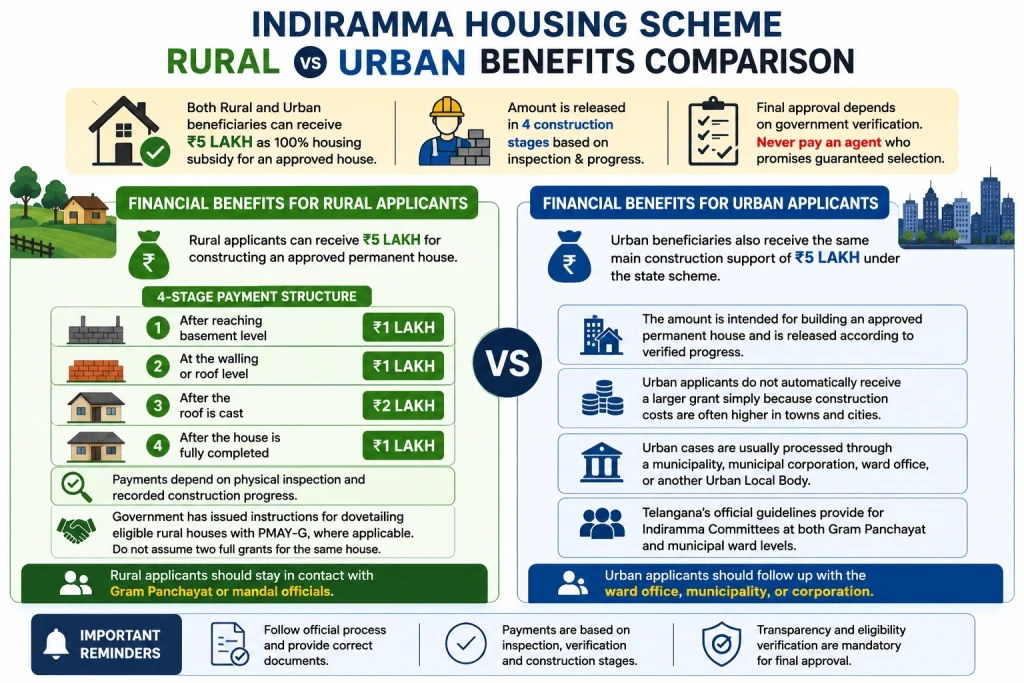
The Indiramma Housing Scheme Rural vs Urban Benefits Comparison shows that both rural and urban beneficiaries can receive ₹5 lakh as a 100% housing subsidy for constructing an approved house. Official district information states that the assistance is released in four construction stages.
In this Rural vs Urban Benefits Comparison, rural applications are generally processed through village-level authorities and Gram Panchayats, while urban applications are handled by municipal wards, municipalities, corporations, or other Urban Local Bodies.
Indiramma Housing Scheme Overview
The Telangana government introduced Indiramma Indlu to support houseless families and people living in huts, semi-permanent homes, or rented houses. Eligible families may receive financial help to build a permanent home on their own site or on a site provided by the government. The scheme targets economically weaker and below-poverty-line households that do not already own a permanent house.
An approved house is expected to provide basic living facilities. Official scheme information describes a minimum house size of around 400 square feet with an RCC roof, kitchen, and toilet.
Rural vs Urban Benefits Comparison at a Glance
| Feature | Rural Beneficiaries | Urban Beneficiaries |
|---|---|---|
| Main construction assistance | ₹5 lakh | ₹5 lakh |
| Subsidy type | 100% subsidy | 100% subsidy |
| Local authority | Gram Panchayat or village officials | Municipal ward, municipality, or corporation |
| Local verification | Village-level survey and Gram Sabha process | Ward-level and Urban Local Body verification |
| House-site requirement | Own site or government-provided site | Own site or approved government-provided site |
| Fund release | Based on construction progress | Based on construction progress |
| Central-scheme coordination | Rural houses may be linked with PMAY-G where applicable | Urban housing may be managed under separate urban housing budget heads |
| Main practical challenge | Land records and village-level verification | Limited land, municipal records, and site approval |
The Telangana budget records rural and urban Indiramma housing under separate administrative budget heads, but this does not automatically mean that individual beneficiaries receive different basic grant amounts.
Financial Benefits for Rural Applicants
Rural applicants can receive ₹5 lakh for constructing an approved permanent house. The assistance is not normally paid as one full advance. Official district implementation details show the following four-stage payment structure:
₹1 lakh after reaching basement level
₹1 lakh at the walling or roof level
₹2 lakh after the roof is cast
₹1 lakh after the house is fully completed
Payments depend on physical inspection and recorded construction progress.
The government has also issued instructions for dovetailing eligible rural houses with PMAY-G, where applicable. This can help coordinate rural housing implementation, but applicants should not assume that they will automatically receive two full grants for the same house.
Financial Benefits for Urban Applicants
Urban beneficiaries also receive the same main construction support of ₹5 lakh under the state scheme.
The amount is intended for building an approved permanent house and is released according to verified progress. Urban applicants do not automatically receive a larger grant simply because construction costs are often higher in towns and cities.
Urban cases are usually processed through a municipality, municipal corporation, ward office, or another Urban Local Body. Telangana’s official guidelines provide for Indiramma Committees at both Gram Panchayat and municipal ward levels.
Land Benefits in Rural Areas
Rural applicants who already own a suitable house site may construct the house on that plot after approval.
Landless families may be considered for a government-provided site, subject to land availability, local verification, and official allocation. Government district pages list both financial assistance and land provision among the scheme’s main benefits.
In rural locations, finding a suitable site may sometimes be easier than in a crowded urban ward. However, applicants still need clear land records and official approval before starting construction.
Land Benefits in Urban Areas
Urban applicants may also receive support when they do not own a house or suitable site. However, site allocation depends heavily on the availability of government land within or near the municipality. Urban land is often limited, so approval may involve additional checks by the municipal authority. Applicants should not begin construction on disputed, unauthorized, or unapproved land.
Possessing an application number or appearing in a survey does not itself prove that a house site has been finally allotted.
Rural Eligibility and Verification
A rural household may be considered when it:
Village-level officials may inspect the current home and proposed construction site. Eligible names may also be reviewed through village or Gram Sabha processes.
The scheme’s mobile system records plot coordinates, photographs, and stage-wise construction progress.

Urban Eligibility and Verification
The basic eligibility conditions are similar for urban families. Applicants should be Telangana residents, belong to an eligible poor household, and not own a permanent house.
The main difference is the verifying authority. Urban applications are checked through ward-level officials, municipalities, corporations, and designated housing staff. Urban applicants may need clear municipal address details, property or site documents, and proof that the family does not already own a registered permanent house.
Is the Rural Benefit Higher Than the Urban Benefit?
No official scheme information reviewed for this comparison shows a higher basic Indiramma construction grant for rural applicants. Likewise, urban applicants are not automatically entitled to more money because labour and material costs may be higher in cities.
Both groups generally receive ₹5 lakh. The real differences are:
Which local authority verifies the application
Whether an approved house site is available
Which housing programme may be coordinated with the case
The local process for construction inspection
Municipal or village-level document requirements
Which Applicants Receive Priority?
The scheme is designed for the poorest and most vulnerable houseless families.
Official eligibility information includes families living in huts, thatched or semi-permanent houses, and rented accommodation. Single women and widowers may also be considered.
Applicants should remember that eligibility does not guarantee immediate sanction. Selection depends on verification, priority, available house allocations, and local approval.
Documents Rural vs Urban Applicants Should Keep Ready
The exact documents may vary, but applicants should generally keep:
Always provide correct information. False ownership, income, or family details can lead to rejection or cancellation.
How to Check an Application
Applicants can search the official Indiramma Indlu portal using a mobile number, Aadhaar number, application ID, or Food Security Card number. The official portal also provides grievance entry and grievance-search options. Its published helpline number is 1800 599 5991.
Use only the official government portal. Avoid websites asking for payment to check a beneficiary list or approve an application.
Helpful Tips for Applicants
Do not start construction before receiving clear approval. Work completed before sanction may not qualify for payment. Make sure the bank account is active and the personal details match the application. Keep photographs and documents for every construction stage.
The Rural vs Urban Benefits Comparison also highlights that rural applicants should stay in contact with their Gram Panchayat or mandal officials, while urban applicants should follow up with the ward office, municipality, or corporation for application updates. Never pay an agent who promises guaranteed selection, as final approval depends on government verification.
FAQs About Rural vs Urban Benefits Comparison
Conclusion
The Indiramma Housing Scheme rural vs urban benefits comparison shows that the core benefit is largely equal. Both eligible groups can receive ₹5 lakh for building a permanent house.
Rural applications move mainly through village and Gram Panchayat systems, while urban applications are handled through municipal wards and Urban Local Bodies. Land availability, document checks, and local approvals may also differ.
Applicants should rely on the official portal, keep their documents ready, and wait for final approval before beginning construction.